
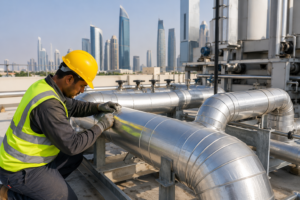
Aluminium Cladding for Pipe Insulation in UAE: A Practical Contractor Guide
Aluminium cladding for pipe insulation is a protective metal jacket installed over an insulated pipe system. It helps shield the insulation from weather, moisture, sunlight, physical impact, and site conditions while allowing the insulation underneath to perform its intended thermal role.
For HVAC contractors, MEP teams, facility managers, consultants, and industrial operators in the UAE, cladding material cannot be selected only by appearance. Pipe location, insulation type, pipe diameter, exposure, operating conditions, project specification, corrosion risk, and maintenance access all matter.
This guide explains how pipe insulation cladding works, where aluminium is suitable, how it compares with GI and stainless steel, what affects thickness and pricing, and what to check before appointing a pipe cladding contractor in the UAE.
What Is Aluminium Cladding for Pipe Insulation?
Aluminium cladding is an outer metallic jacket fitted over thermal insulation surrounding chilled-water, refrigerant, hot-water, process, or other mechanical piping.
The insulation and the cladding perform different jobs.
The insulation controls heat transfer and, where applicable, helps manage surface condensation. The cladding protects that insulation system from external exposure and damage.
ASTM C1729 specifically covers aluminium jacketing for thermal and acoustical insulation used above or below ambient temperatures and in both indoor and outdoor applications. The standard addresses properties including aluminium classification, thickness, surface treatment, and moisture-retarder considerations.
For UAE projects, this distinction is important. Installing good insulation and leaving it poorly protected can undermine the durability of the complete insulation system.
Why Is Pipe Cladding Required in UAE HVAC Projects?
Pipe cladding is mainly required to protect the insulation underneath.
Outdoor and exposed pipework may face sunlight, dust, moisture, maintenance traffic, accidental impact, and changing environmental conditions. Once insulation becomes torn, wet, displaced, or exposed, its thermal performance can deteriorate.
Bright Star currently provides pipe cladding for chilled-water and mechanical lines using aluminium and GI materials and positions these services for residential, commercial, and industrial UAE projects.
A well-designed HVAC pipe cladding system can therefore help:
- protect the insulation from weather and physical damage;
- create a durable external finish;
- reduce opportunities for moisture intrusion when joints are correctly detailed;
- make insulated pipework easier to inspect and maintain;
- extend the usable life of the insulation system;
- provide a clean finish for plant rooms and exposed services.
Cladding does not compensate for poorly selected insulation or incorrect vapour-control detailing. It must be treated as one layer within the complete pipe insulation system.
What Materials Are Used for Pipe Cladding?
The most common choices include aluminium, galvanised steel and stainless steel, although project specifications may call for other jacketing systems.
| Material | Typical Strength | Considerations |
|---|---|---|
| Aluminium | Lightweight, corrosion-resistant, easy to fabricate | Thickness and alloy should match the specification |
| GI / galvanised steel | Strong and mechanically durable | Heavier and corrosion protection should suit exposure |
| Stainless steel | High durability and corrosion resistance | Higher material cost |
| Flexible membrane jacketing | Conforms around complex shapes | Must suit operating conditions and project specification |
Flexible systems are also available in the market. For example, FlexClad describes its system as a weather-resistant jacketing solution for insulated piping and ductwork, including exterior applications.
The correct choice should come from the project requirement rather than simply choosing the cheapest sheet material.
Which Cladding Material Is Best for Insulated Pipes?
There is no single best material for every insulated pipe.
Aluminium is often attractive because it combines low weight, fabrication flexibility, corrosion resistance, and a neat finished appearance. GI can suit applications where greater mechanical strength is desired. Stainless steel may be specified where higher corrosion resistance, hygiene, durability, or particular industrial conditions justify its cost.
Material selection should consider:
- Indoor or outdoor installation
- Chilled, hot, steam, refrigerant, or process service
- Pipe and insulation diameter
- Mechanical abuse risk
- Corrosive environment
- Required finish
- Project specification
- Consultant requirements
- Maintenance requirements
- Budget
For oil and gas, industrial, marine, utility, or specialist facilities, the approved project specification should take priority over generic recommendations.
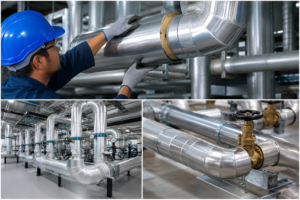
Aluminium vs GI vs Stainless Steel Pipe Cladding
Aluminium Pipe Cladding
Aluminium is lightweight and relatively easy to cut, roll, form, and install around straight pipe sections, elbows, valves, reducers, and fittings.
It is frequently suitable for HVAC and chilled-water pipe insulation where a weather-resistant external metal jacket is needed.
GI Pipe Cladding
GI cladding provides a strong external shell and can be useful where increased mechanical resistance is required.
The suitability of the galvanised coating should still be assessed against the project environment and expected exposure.
Stainless Steel Pipe Cladding
Stainless steel offers higher resistance to many corrosive environments and provides a highly durable external jacket.
It may therefore be considered for industrial, coastal, process, food-related, or other demanding environments when the project specification requires it.
The decision should be based on service conditions and specification, not merely initial material price.
What Thickness of Aluminium Cladding Is Used for Pipes?
Aluminium thickness should be determined from the pipe insulation diameter, insulation rigidity, mechanical exposure, project requirements, and referenced standard.
It is incorrect to assume that one thickness suits every pipe.
ASTM C1729 includes minimum pipe-jacketing thickness requirements that change according to the outer insulation diameter and whether the insulation is rigid or non-rigid. The SI equivalents referenced by ASTM include common aluminium thickness values such as 0.4 mm, 0.5 mm, 0.6 mm, 0.8 mm and 1.0 mm, depending on the application.
Therefore, a contractor should not quote a cladding thickness simply from the nominal pipe diameter.
The engineer should first confirm:
pipe OD + insulation thickness = outer insulated diameter
Then the selected cladding specification can be checked against the project requirement.
That small step prevents a common procurement error.
What Type of Cladding Is Best for Outdoor Pipes in the UAE?
For outdoor UAE pipework, the best cladding is the system that provides the required weather resistance, mechanical protection, joint integrity and corrosion suitability for that particular location.
Aluminium is frequently useful for external HVAC applications because it is lightweight and corrosion resistant. However, correct detailing matters as much as the material itself.
A good outdoor system needs careful treatment of:
- longitudinal joints;
- circumferential joints;
- elbows and tees;
- valves and flanges;
- pipe supports;
- terminations;
- penetrations;
- removable sections;
- areas where water could collect.
Weatherproofing failures typically occur at details and joints rather than in the middle of a correctly installed sheet.
That is why workmanship should be evaluated alongside metal type and thickness.
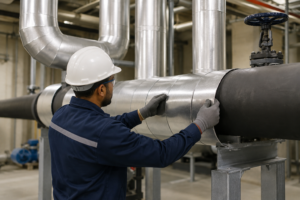
How Does the Pipe Cladding Process Work?
A professional pipe cladding process usually follows several practical stages.
1. Inspect the Pipe and Insulation
The contractor checks pipe size, insulation condition, location, access, fittings, supports, and external exposure.
Damaged or wet insulation should be addressed before permanent metal cladding covers it.
2. Confirm the Specification
The team confirms the required cladding material, thickness, finish, joint arrangement, fastening method, moisture barrier requirements, and special project details.
3. Measure the Finished Insulated Diameter
Cladding is fabricated around the finished insulation system rather than the bare pipe alone.
4. Fabricate Straight Sections and Fittings
Sheets are cut and formed for straight pipe runs. Elbows, tees, reducers, valve boxes, end caps, and unusual details require separate fabrication.
5. Install the Cladding
The fabricated pieces are positioned over the insulation with suitable overlap, orientation, fastening and joint treatment.
6. Seal Vulnerable Locations
Outdoor penetrations, terminations, joints and fittings require particular attention to reduce opportunities for water entry.
7. Inspect the Completed Work
The final inspection should check alignment, loose sheets, sharp edges, open joints, poor overlaps, damaged insulation, missing sections and incomplete sealing.
This is where a specialist pipe insulation and cladding contractor adds value. The quality of fabrication and detailing directly affects the finished system.
Chilled Water Pipe Cladding Requires Special Attention
Chilled-water systems require careful coordination between the pipe, insulation, vapour-control layer and external cladding.
Cladding itself does not stop condensation if the underlying insulation and vapour-control system are incorrectly designed or damaged.
For a chilled-water project, the contractor should check that:
- insulation remains continuous;
- vapour-control layers are not unnecessarily punctured;
- joints are properly treated;
- supports and fittings are correctly insulated;
- cladding does not create obvious water traps;
- damaged insulation is repaired before closing the system.
This distinction is particularly important for facility managers. Replacing a metal jacket alone may not solve condensation if the underlying insulation system has already failed.
What Affects Pipe Cladding Cost in the UAE?
There is no reliable universal pipe cladding price per meter because the same linear length can require very different amounts of metal, fabrication and labour.
The main cost factors are:
- pipe diameter;
- insulation thickness;
- cladding material;
- aluminium or steel thickness;
- straight pipe versus fittings;
- number of elbows, valves and tees;
- indoor versus outdoor work;
- working height;
- scaffolding or access requirements;
- congested plant-room conditions;
- removal of existing cladding;
- insulation repair;
- project quantity;
- required finish;
- mobilisation and site restrictions.
For example, 100 metres of small straight pipe at accessible level cannot be priced the same way as 100 metres containing large-diameter insulated pipes, numerous valves and elevated outdoor sections.
For procurement teams, requesting only a “rate per metre” without sharing sizes and fittings can therefore produce misleading quotations.
How to Prepare a Better Pipe Cladding RFQ
For a more accurate quotation, send the contractor:
Pipe service: chilled water, refrigerant, hot water, process, etc.
Pipe diameter: preferably a size schedule
Insulation thickness: by pipe size
Approximate quantity: linear metres
Cladding material: aluminium, GI or stainless steel
Required thickness: if specified
Location: indoor/outdoor
Height/access: ground level, ceiling, roof, shaft, plant room
Fittings: approximate elbows, valves, tees and reducers
Existing condition: new work or replacement
Drawings/photos: where available
Project specification: consultant or client requirements
This information helps contractors estimate material consumption, fabrication complexity and labour much more accurately.
How Do I Choose a Pipe Cladding Contractor in the UAE?
Choose a contractor based on the ability to execute the complete insulation-protection detail, not simply supply sheet metal.
Before appointing a contractor, ask:
- Do you handle aluminium, GI and specialist cladding?
- Can you fabricate elbows, valve boxes and complex fittings?
- Will you inspect the insulation before covering it?
- Can you follow consultant drawings and specifications?
- How will outdoor joints and terminations be detailed?
- Is the quotation clear about metal thickness and material?
- Are access equipment and removal works included?
- Can you provide relevant project examples?
- Who handles inspection and snag rectification?
- What information is required before final pricing?
Bright Star Central A/C Works states that it has operated since 2007 and completed more than 200 projects across residential, commercial and industrial sectors. Its website currently lists aluminium and GI pipe cladding as well as duct cladding and HVAC services.
Pipe Cladding and Duct Cladding Should Be Planned Together
Many HVAC projects contain both exposed insulated pipework and insulated ducts.
Although the fabrication details differ, both systems share the same basic principle: the insulation needs an appropriate external protective layer where exposure requires it.
Bright Star also provides aluminium cladding for ductwork, so contractors and facility teams managing complete HVAC packages can coordinate pipe and duct protection within the same project scope.
For pipe-specific requirements, see Bright Star’s Pipe Cladding Abu Dhabi, UAE service page.
For related HVAC duct protection, see the company’s aluminium cladding for ductwork service offering, which is also listed in the site’s service navigation.
When Should Existing Pipe Cladding Be Replaced?
Replacement should be considered when the jacket can no longer protect the insulation effectively.
Warning signs include:
- missing cladding sections;
- open or separated joints;
- crushed metal;
- loose bands or fasteners;
- punctures;
- corrosion;
- visible wet insulation;
- exposed insulation;
- badly damaged elbows or valve boxes;
- repeated condensation around compromised areas.
Do not automatically reclad over damaged insulation. The underlying condition should first be inspected.
Otherwise, new metal may simply hide the existing problem.
Frequently Asked Questions
What materials are used for pipe cladding?
Common pipe cladding materials include aluminium, galvanised steel, stainless steel and specialised weatherproof jacketing systems. The right material depends on the pipe service, location, corrosion exposure, mechanical risk and project specification.
Which cladding material is best for insulated pipes?
Aluminium is often suitable for HVAC pipe insulation because it is lightweight, corrosion resistant and easy to fabricate. GI may provide greater mechanical strength, while stainless steel can be selected for more demanding corrosive or industrial conditions.
What thickness of aluminium cladding is used for pipes?
There is no single thickness for every pipe. Standards such as ASTM C1729 relate minimum jacketing thickness to the finished outer insulation diameter and insulation type. Project specifications should always be checked before fabrication.
What type of cladding is best for outdoor pipes in the UAE?
A weather-resistant system with properly fabricated and sealed joints is required. Aluminium is widely applicable, but GI or stainless steel may be more suitable where mechanical or corrosion conditions demand them.
How much does pipe cladding cost in the UAE?
Pricing depends on pipe diameter, insulation thickness, metal type, cladding thickness, fittings, access, quantity and site conditions. A site survey or detailed quantity schedule is the most reliable basis for quotation.
What affects the cost of pipe cladding installation?
The biggest cost variables are material quantity, pipe size, fittings, fabrication complexity, working height, access, existing insulation condition and whether old cladding must be removed.
How do I choose a pipe cladding contractor in the UAE?
Check relevant experience, fabrication capability, material options, specification compliance, quality of joint detailing, quotation clarity and the contractor’s ability to inspect the insulation before cladding.
How can I get a quotation for pipe cladding in the UAE?
Provide pipe sizes, insulation thicknesses, approximate lengths, fittings, required cladding material and thickness, project location, access details, drawings and photographs where possible. A site inspection can then confirm the final scope.
Protect the Insulation, Not Just the Pipe
Good pipe cladding work starts with one question: what must the insulation be protected from on this particular project?
Once the service condition, exposure, pipe size, insulation system and project specification are understood, the contractor can select an appropriate aluminium, GI or stainless-steel cladding solution and detail it correctly.
For HVAC contractors, MEP companies, facility managers, consultants, developers and industrial operators requiring aluminium cladding for pipe insulation in Abu Dhabi or elsewhere in the UAE, Bright Star Central A/C Works provides pipe and duct cladding services for commercial, residential and industrial HVAC applications.
A detailed RFQ or site inspection is the best next step because it allows the cladding material, thickness, fitting quantity, access requirements and installation scope to be priced against the actual project rather than a generic metre rate.